Poster
Poster tidak tersedia
Foto Alat
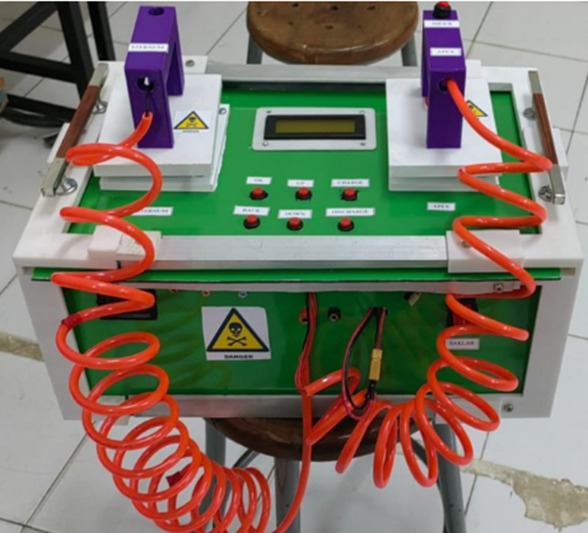
Penjelasan Alat
A Microcontroller-Based Portable Defibrillator is a simple medical device designed to provide an electric shock (defibrillation) to patients experiencing cardiac arrest. This tool uses an Arduino Mega 2560 microcontroller to regulate the process of charging and discharging energy in a capacitor so as to produce an electric shock with a certain energy level. Objective: To design and make a simple defibrillator that can work using a DC power source from a Li-Po battery and is controlled by a microcontroller to make it more efficient, portable and safe to use in emergency situations. Urgency of the Tool: Many defibrillators on the market still rely on PLN electricity and are high priced. This tool was developed so that it can be an alternative solution for domestically made portable defibrillators, supports policies to increase the use of local products, and helps treat cases of cardiac arrest with a low-cost and easy-to-use tool. Tool Innovation: Uses DC power source from Li-Po batteries, not PLN; Arduino Mega 2560 based control system; biphasic energy settings with 20J–60J options; has an automatic discharge system for safety; and is equipped with an LCD for displaying energy values and equipment status. Product Advantages : 1. Portable and power saving.2. Using microcontroller-based automatic control.3. Can be operated without PLN electricity.4. Equipped with an overload discharge safety system.5. Open-source components that are easy to obtain and develop How it works: The device is powered using a Li-Po battery. User selects energy level (20J–60J) via input button. Arduino regulates the charging of the capacitor until it reaches the desired voltage. Once ready, the tool can be used to deliver an electric shock (simulative) through the electrode, or discharge energy to ground via an automatic discharge system. This product is able to answer the need for a simple defibrillator that is efficient, portable and affordable for educational, research or medical simulation purposes. In addition, this tool supports increasing the technological independence of Indonesian-made medical devices as well as implementing project-based learning in the field of medical electronics.